Medicare Supplement Plans
Table of Contents
Medicare Supplement insurance (Medigap) fills the gaps that Original Medicare leaves behind — copayments, coinsurance, deductibles, and excess charges that can add up fast. If you have Medicare Part A and Part B, a Medigap policy from a private insurer pays some or all of those remaining costs, giving you more predictable out-of-pocket expenses and the freedom to see any provider that accepts Medicare.
There are 10 standardized plan letters to choose from, each covering a different combination of benefits. Below, we break down exactly what each plan covers, how to choose the right one, and when to enroll to lock in the best rates.
Medicare rates, deductibles, and rules update every year. The 2026 figures below reflect the latest CMS announcements at the time of writing — confirm current details on Medicare.gov or with a licensed agent before enrolling.
How Medicare Supplement Plans Work with Original Medicare
Medigap policies are designed to work alongside Original Medicare — not replace it. You must be enrolled in both Medicare Part A and Part B before you can buy a Medigap plan. Here is how the payment process works:
- You receive medical care from any doctor or hospital that accepts Medicare (no network restrictions).
- Medicare pays its share of the approved amount.
- Your Medigap plan pays some or all of the remainder — copayments, coinsurance, or deductibles — depending on which plan letter you have.
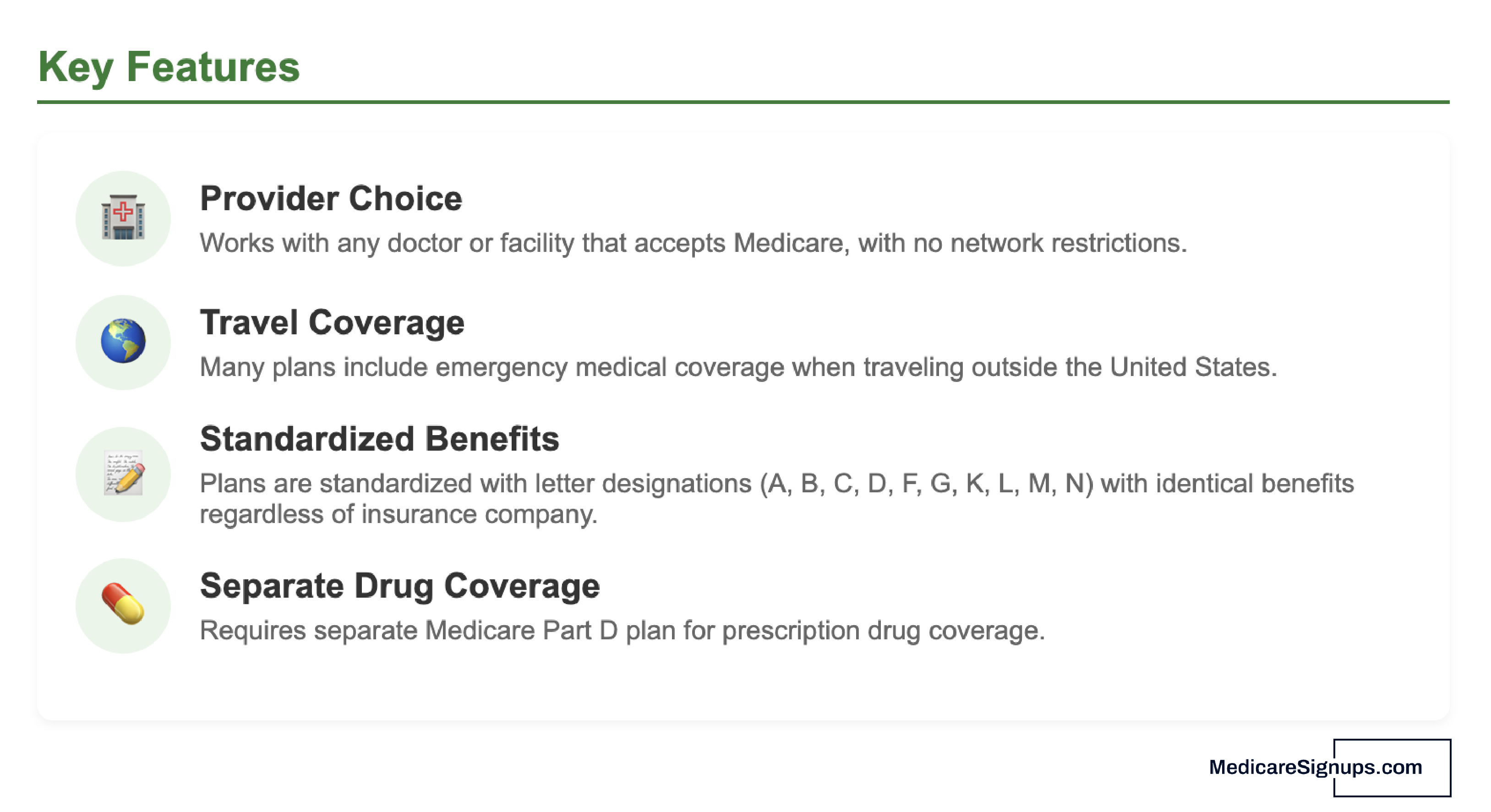
Unlike Medicare Advantage, Medigap plans do not include prescription drug coverage. If you need drug coverage, you will need to enroll in a separate Medicare Part D plan. Comparing the best Part D options alongside your Medigap choice ensures complete coverage.
The 10 Standardized Medicare Supplement Plan Letters
Every Medigap plan sold in most states is standardized by the federal government, meaning Plan G from one insurance company covers exactly the same benefits as Plan G from another. The only differences between insurers are price, customer service, and financial stability. Here is what each plan covers:
Most Popular Plans
- Plan G — Covers nearly everything: Part A and B coinsurance, hospital costs, skilled nursing coinsurance, Part A and B deductibles (except the Part B deductible), Part B excess charges, and foreign travel emergency care. The most comprehensive plan available to new enrollees.
- Plan N — Similar to Plan G but with lower premiums in exchange for small copays (up to $20 for some office visits, up to $50 for ER visits that do not result in admission). Does not cover Part B excess charges. A strong value option for people who want to save on premiums.
High-Deductible Option
- Plan G High Deductible — Same coverage as Plan G, but you pay a calendar-year deductible (set by Medicare, $2,950 for 2026) before the plan begins paying. Premiums are significantly lower.
Other Available Plans
- Plan A — Basic benefits only: Part A and B coinsurance, hospital costs, blood, and hospice coinsurance. No deductible coverage, no excess charges, no foreign travel.
- Plan B — Plan A benefits plus the Part A deductible.
- Plan C — Comprehensive coverage including both Part A and Part B deductibles. Only available to people who became eligible for Medicare before January 1, 2020.
- Plan D — Covers everything except the Part B deductible and Part B excess charges.
- Plan F — The most comprehensive plan ever offered, covering all gaps including the Part B deductible. Only available to people who became eligible for Medicare before January 1, 2020. See our analysis of 2026 Plan F prices for current costs.
- Plan K — Covers 50% of most cost-sharing benefits with a maximum annual out-of-pocket limit.
- Plan L — Covers 75% of most cost-sharing benefits with a maximum annual out-of-pocket limit.
- Plan M — Covers 50% of the Part A deductible plus most other benefits. Does not cover the Part B deductible.
Note: Massachusetts, Minnesota, and Wisconsin use their own standardized plan structures instead of the letter system above.
"The basic plan is the same across the United States. Plan G is a Plan G and is controlled by Medicare. Sure, carriers often include a few extra perks or riders with their plans. But nothing is free. They can't regulate the plans, but can control their cost," says Larry Dalton, a licensed Medicare agent in Oklahoma. That is why agents routinely tell shoppers to pick the plan letter first and then shop the price — the coverage will not change between carriers, but the premium can swing by hundreds of dollars a year for the exact same benefits.
Key Benefits of Having a Medigap Policy
- Predictable costs: With comprehensive plans like G and N, most covered expenses beyond your premium are paid by the plan, so you can budget with confidence. Only Plans K and L carry a federally-set annual out-of-pocket maximum — the other letters do not have a hard cap, though covered gaps are minimal.
- Freedom to choose any provider: Medigap has no networks. You can see any doctor or visit any hospital that accepts Medicare, anywhere in the country.
- No referrals needed: You do not need a primary care doctor's referral to see a specialist. This is especially valuable for people managing conditions like heart disease who see multiple providers.
- No claim forms: Medicare and your Medigap insurer handle the billing between themselves.
- Coverage travels with you: Unlike many Medicare Advantage plans, Medigap works nationwide. Some plans also include foreign travel emergency coverage.
That nationwide freedom is the single biggest reason agents steer frequent travelers toward Medigap. "If someone travels extensively throughout the year, it usually makes the most sense for them to be in a Medigap plan," says Steve Brauer, a licensed Medicare agent in Arizona. "With a Medigap plan, the person can see any doctor in the United States, as long as they accept Medicare patients. With international travel I always recommend a separate travel medical policy."
How to Choose the Right Medicare Supplement Plan
Choosing between Medigap plans comes down to balancing monthly premium costs against potential out-of-pocket risk. Here is a practical framework:
If you want maximum coverage and minimal surprises: Plan G is the go-to choice for most new enrollees. It covers virtually all gaps except the annual Part B deductible (which is $283 for 2026). For a detailed comparison, see our breakdown of Plan G vs. Plan N.
If you want lower premiums and are comfortable with small copays: Plan N offers solid coverage at a lower monthly cost. You will pay up to $20 for some office visits and up to $50 for ER visits that do not lead to hospital admission, but your premiums could be $30-$60 less per month than Plan G. Our breakdown of 2026 Plan N prices shows what you can expect to pay by region.
If you want the lowest possible premium: High-Deductible Plan G keeps your monthly cost very low. You pay the first $2,950 of covered expenses each year, then the plan covers everything. This works well for healthy beneficiaries who rarely use medical services.
If you became Medicare-eligible before 2020: You may still be able to enroll in Plan F or Plan C, which are no longer available to newer enrollees. Plan F covers everything including the Part B deductible.
Medicare Supplement Costs and Pricing
Medigap premiums vary significantly based on several factors:
- Your age: Most policies use attained-age rating, meaning premiums increase as you get older. Some use issue-age or community rating — these tend to be more stable over time.
- Your location: Premiums differ by state and even by zip code.
- The insurance company: Because benefits are standardized, the same plan can cost very different amounts from different insurers. Shopping around is essential.
- Tobacco use and gender: Some states allow insurers to factor in tobacco use and gender when setting premiums.
- Household and payment discounts: Many insurers offer discounts for married couples, auto-pay, or annual payment.
"Medigap costs depend on your insurer, state, age, and plan — they typically range from $50 to $300+ per month," says Mila Grayevsky, a licensed Medicare agent in New York. "The value comes from covering copays and deductibles. Plans like G or N give good protection, while simpler ones like A cover less." That spread is why two people in the same zip code, on the same plan letter, can end up paying very different premiums depending on which insurer they choose.
For current pricing data, see our analysis of 2026 Plan G prices across the country.
When to Enroll: Medigap Open Enrollment and Guaranteed Issue
The single most important enrollment window for Medigap is your Medigap Open Enrollment Period. This is a one-time, 6-month window that starts the month you turn 65 and are enrolled in Medicare Part B. During this period:
- Insurance companies cannot deny you coverage for any reason.
- They cannot charge you more because of health conditions.
- You can buy any Medigap plan sold in your state.
After this window closes, insurers can use medical underwriting — they can deny coverage or charge higher premiums based on your health history. "Yes, you can be denied a Medicare Supplement plan if you apply outside your Open Enrollment Period or without a guaranteed issue right," says Brandon Brown, a licensed Medicare agent in Kentucky. "During your 6-month Open Enrollment, insurers must accept you no matter your health. Outside of that, companies can ask health questions, charge more, or deny coverage. Some states offer more protections, but in most places, timing is key to avoid being denied." This makes enrolling during your open enrollment period critical. For full details on timing and eligibility, read our guides on Medicare Supplement enrollment periods and Medicare Supplement eligibility.
Medicare Supplement vs. Medicare Advantage
Many people compare Medigap to Medicare Advantage when deciding how to structure their Medicare coverage. Here are the key differences:
Medigap (Medicare Supplement)
- Works with Original Medicare (Part A and Part B)
- No provider networks — see any doctor who accepts Medicare
- Monthly premium in addition to Part B premium
- Little to no out-of-pocket costs for covered services
- Does not include prescription drug coverage
- Does not include dental, vision, or hearing benefits
Medicare Advantage (Part C)
- Replaces Original Medicare with a private plan
- Usually requires using in-network providers
- Many plans have $0 or low monthly premiums
- Copays and coinsurance apply at time of service
- Usually includes Part D drug coverage
- Often includes dental, vision, hearing, and fitness benefits
Neither option is universally better — the right choice depends on your health needs, budget, preferred doctors, and how often you travel. For a deeper comparison, read our guide on comparing Medicare coverage options.
Frequently Asked Questions
Can I have both a Medigap plan and a Medicare Advantage plan?
No. Federal law prohibits insurance companies from selling you a Medigap policy if you are enrolled in a Medicare Advantage plan. You must choose one or the other.
Does Medigap cover prescription drugs?
No. Medigap plans sold after 2006 do not include prescription drug coverage. You will need a separate Medicare Part D plan for drug coverage.
Can I switch Medigap plans later?
You can apply to switch plans at any time, but outside your initial open enrollment period, you may be subject to medical underwriting. Don't fall for common Medicare myths about when you can and can't switch. Some states have additional protections — check your state's rules.
It is worth understanding why insurers can do this in the first place. "Medicare and a Medicare supplement are two completely different things," explains Cleo Martin, a licensed Medicare agent in South Carolina. "Medicare is what you paid into. A Medicare supplement is from a private insurance company. They have underwriting questions that you have to be able to answer correctly or they can deny you. The supplement works with Medicare to pay what Medicare doesn't pay." That distinction surprises a lot of people, but it is the reason timing your Medigap enrollment matters so much.
What if I have questions about which plan is right for me?
Speaking with a local Medicare insurance agent is one of the best ways to get personalized guidance at no cost to you. Licensed agents can compare plans and prices in your area.